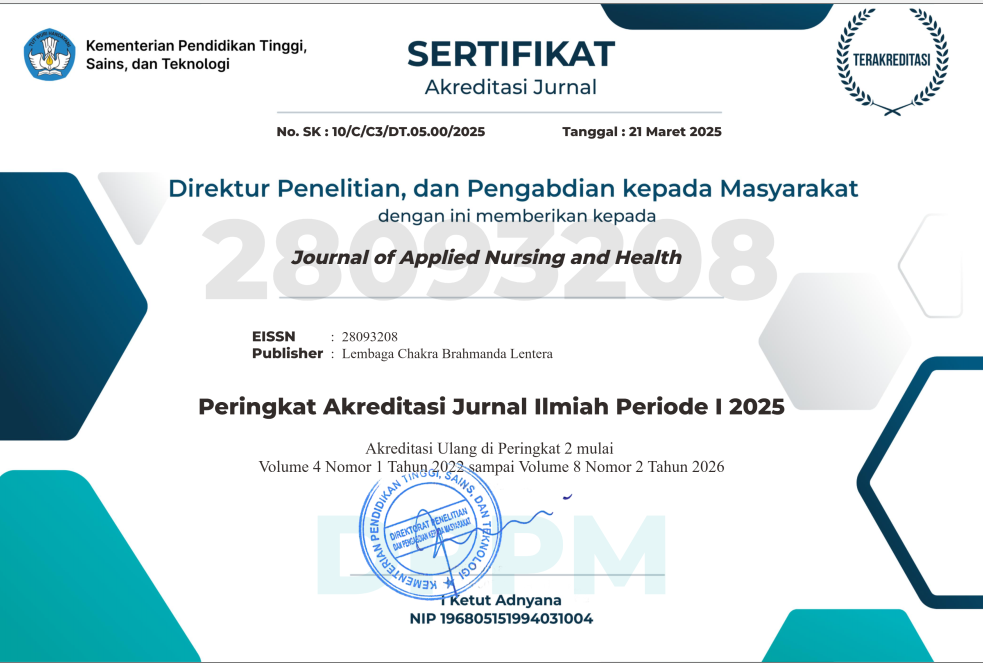
Edition Volume 8 No. 1, 2026
Acceptance Rate: 53%
Rejection Rate: 47%
Reviewers: 77

Manuscripts submitted to the Chief Editor of the Journal of Applied Nursing and Health (JANH) were submitted online.
Already have a Username/Password for Jurnal?
Need a Username/Password?
Registration and login are required to submit items online and check current submissions' status. If you have further questions, please contact the admin at the telephone number (Whatsapp) +62 857-3387-8003 or email [email protected].
As part of the submission process, authors must check off their submission's compliance with all of the following items, and submissions may be returned to authors who do not adhere to these guidelines.
All submitted articles are original and original manuscripts and have never been published in any journal.
The Journal of Applied Nursing and Health (JANH) publishes the following types of manuscripts:
Note: JANH does not allow duplicate or redundant publication. Manuscripts must be original, unpublished work, and not under consideration by other journals.
All authors must meet the ICMJE criteria for authorship:
All contributors who do not meet these four criteria should be acknowledged appropriately. Manuscripts must include an author contribution statement using the CRediT taxonomy. Ghost authorship, guest authorship, or gift authorship is not permitted.
⭐⬇️Download Template Journal Here⬇️⭐
Article Title
Authorship
The JANH clearly explains the guidelines for publishing each study in journals. The JANH ensures high quality for each manuscript so authors must follow the template provided or be guided by the EQUATOR Network or NLM's Research Reporting Guidelines and Initiatives. Authors can click on the Guidelines below according to the type of study to be published:
Note: Manuscripts employing a pre-experimental design are only considered if they serve as a pilot study or demonstrate significant scientific novelty. Authors are encouraged to clearly state the pilot objectives, methodological limitations, and the practical or future research implications.
The following section provides comprehensive author guidelines outlining the required structure, content, and formatting standards for manuscript preparation and submission.
The title should be clear and specific (10–16 words), include key terms, subjects, methodology, and research significance, and clearly indicate the review type.
The abstract should not be more than 250 words. There is no citation in the abstract. If possible, remove all uncommon abbreviations.
For keywords of an abstract, use MeSH on Demand by the US National Library of Medicine.

Concise (3 points), highlight how research findings can be applied to improve patient care, clinical decisions, and healthcare policies.
This section outlines the research problem and gaps in prior studies, explains its importance for nursing and health outcomes, presents the theoretical framework and variable relationships, and states the study’s contribution and research objectives.
Identify the research design used, such as correlational, quasi-experimental, cross-sectional, and longitudinal studies.
This section describes the sampling strategy, inclusion and exclusion criteria, participant recruitment process, and sample size, including its calculation or justification.
This section specifies the instrument’s development or modification status, validity and reliability, name and citation, permission from the original authors, and a brief description of its type, scale, and use.
This section (for experimental studies only) briefly explains the intervention process, setting, personnel involved, and, if applicable, the control group intervention.
This section describes the time and location of data collection, who collected the data, and the involvement of any research assistants or enumerators.
This section describes the data analysis techniques and any software used to test the hypotheses.
This section states the ethical considerations, ethics committee approval (including institution and approval number), any additional approvals, or a clear statement that ethical approval was not required.
This section outlines the qualitative research approach, explains the rationale for selecting the design, and describes the research setting and its potential influence on the findings.
This section describes the researchers’ background and relationship with participants and explains the strategies used to minimize researcher bias.
This section defines the inclusion and exclusion criteria, explains participant recruitment and awareness of the study aims, reports participation numbers and refusals, and states whether any incentives were provided.
This section specifies the time and setting of data collection, describes the data collection methods and interview procedures, and explains recording, transcription accuracy, member checking, and how data saturation was achieved.
This section describes the qualitative data analysis method, software used, coding procedures, theme development, researcher validation, conflict resolution, and supporting methodological references.
This section outlines the validation techniques used, including participant review and strategies to ensure credibility, dependability, confirmability, and transferability of the findings.
This section confirms ethical approval and any additional permissions, or provides justification if approval was not required, and explains informed consent procedures and how participant confidentiality and anonymity were maintained.
This section explains the use of the PRISMA framework and clearly identifies the research question guiding the review.
This section states whether a review protocol exists, and where it can be accessed. It provides registration details (including the registration number) and recommends registering the protocol in PROSPERO if not already done.
This section specifies the inclusion and exclusion criteria for the review and explains how the included studies were grouped for synthesis.
This section specifies all information sources used to identify studies, along with the dates on which each was last searched or consulted.
This section presents the complete search strategies for all databases, registers, and websites, including any filters and limits applied.
This section specifies the study selection methods, including the number of independent reviewers involved, their screening process, and any automation tools used.
This section specifies the data collection methods, including the number of independent reviewers involved, processes for confirming data, and any automation tools used.
This section lists and defines all outcomes and other variables for which data were sought, explains how compatible results were selected, and describes assumptions made for missing or unclear information.
This section specifies the methods and tools used to assess risk of bias, the number of independent reviewers involved, and any automation tools applied.
This section specifies, for each outcome, the effect measures used to synthesize or present the results (optional for systematic reviews).
This section describes the eligibility processes for each synthesis, data preparation methods, result presentation, synthesis techniques, meta-analysis models, heterogeneity assessment, exploration of heterogeneity, and any sensitivity analyses conducted.
This section describes the methods used to assess the certainty or confidence in the body of evidence for each outcome.
This section presents sample characteristics, study aims, and hypotheses, and statistical analysis results using clear subheadings, while indicating whether each hypothesis was supported or rejected. Tables and figures are limited in number, referenced in the text without repetition, and include the relevant statistical tests used.
This section compares the findings with the theoretical framework and previous studies, highlighting similarities and differences. It also summarizes the new knowledge contributed by the study, indicating whether it supports or challenges existing theories and its implications for future research or practice.
This section explains the study’s conceptual and scientific contributions to theory and future research while acknowledging limitations related to sample size, representativeness, and generalizability.
The findings of this study can be directly applied in nursing practice, healthcare settings, and the community by informing evidence-based decision-making, guiding professional practice improvements, and supporting institutions and policymakers in developing strategies or policies aligned with the study’s results.
The conclusion summarizes the study’s main findings and emphasizes the key take-home message that reflects the study’s overall contribution and significance.
The following guidelines outline the standards for tables, figure legends, and references to ensure clarity, consistency, and compliance with the journal's formatting requirements.
Tables should be self-contained and complement, not duplicate, the information contained in the text. They should be supplied as editable files, not pasted as images. Legends should be concise but comprehensive – the table, legend, and footnotes must be understandable without referencing the text. All abbreviations must be defined in the footnotes. Footnote symbols: †, ‡, §, ¶, should be used (in that order) and *, **, *** should be reserved for values. Statistical measures such as SD or SEM should be identified in the headings. Put the tables in the main content in the appropriate position instead of putting them under the references.
Legends should be concise but comprehensive – the figure and its legend must be understandable without referencing the text. Include definitions of any symbols used and define/explain all abbreviations and units of measurement.
Authors must use Mendeley (Download for free) as the reference manager and apply the APA 7th Edition citation style. Manuscripts must include at least 20 up-to-date references (published within the last 10 years), with a minimum of 85% sourced from journal articles. Each reference should include a DOI or URL, and abstracts are not permitted to be cited. [Example of References]